

Naive RAG cannot fix broken enterprise context. When critical operational knowledge sits trapped across contracts, service logs, and engineering specs, connecting sap data with unstructured documents becomes the single greatest bottleneck to autonomous execution. Isolated tables, rigid BAPIs, and disconnected vector fragments don’t communicate. Instead, they produce costly hallucinations, operational bottlenecks, and severe compliance exposures the instant sensitive data leaves your core ERP perimeter.
You already know that manual document reconciliation drains operational velocity, yet duct-taping external vector stores to relational schemas only compounds the chaos. Discover how to bridge structured SAP transactional data with unstructured enterprise documents to establish deterministic context and fuel governed AI workflows. We will examine the architectural shift required to ground autonomous agents in verifiable business records while maintaining complete governance and live operational memory.
Key Takeaways
- Uncover why point-to-point ETL and isolated vector databases fail to resolve the semantic divide between rigid SAP relational tables and unstructured files.
- Discover how connecting sap data with unstructured documents using a context graph architecture establishes deterministic relational fidelity and live operational memory.
- Follow a five-step implementation blueprint to systematically extract core ERP entities, ingest multi-cloud documents, and map complex enterprise relationships.
- Preserve native SAP authorization models and bidirectional lineage to eliminate model hallucinations while meeting strict regulatory standards.
- Transition enterprise operations from passive document retrieval to autonomous, governed AI agents capable of executing multi-system workflows.
The Enterprise Impedance Mismatch: Why SAP Data and Unstructured Documents Remain Siloed
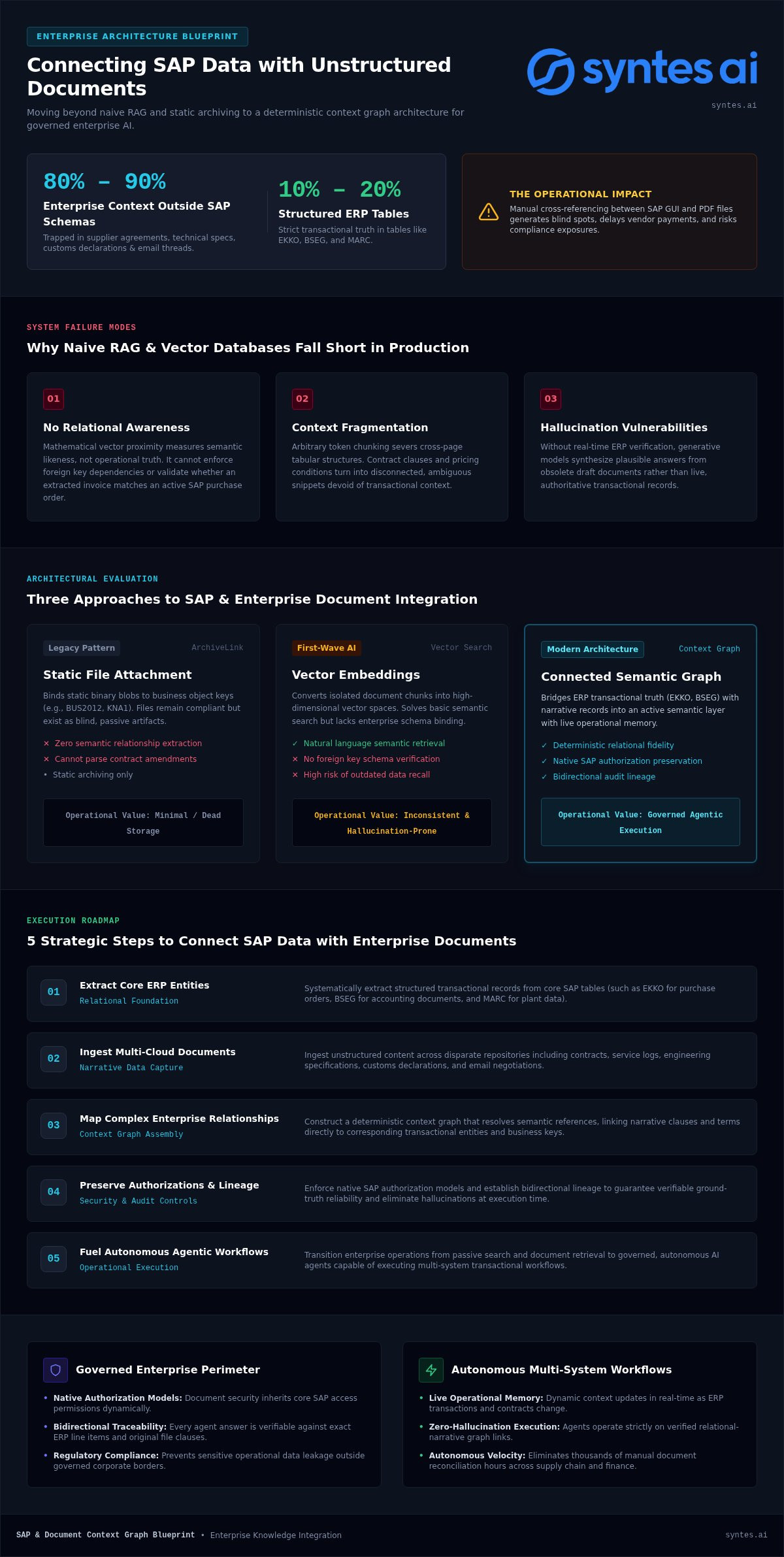
Enterprise transactional truth lives inside SAP tables like EKKO, BSEG, and MARC. These relational databases enforce exact financial controls, material valuations, and order statuses. Yet roughly 80% to 90% of enterprise context exists entirely outside these schemas. It sits buried in supplier agreements, technical specifications, customs declarations, and email threads. Connecting sap data with unstructured documents is rarely treated as an operational requirement; instead, organizations historically relegated files to static archiving or one-off migration initiatives.
This structural separation creates systemic friction. A purchase order in SAP documents the quantitative commitment, but the narrative justification, liability boundaries, and penalty clauses sit in a disconnected PDF. When supply chain disruptions occur, operational teams waste thousands of manual hours cross-referencing lines in SAP GUI against unstructured files. The resulting blind spots stall order fulfillment, delay vendor payments, and generate substantial audit vulnerabilities.
The Structural Gap Between Relational Tables and Narrative Text
Relational schemas demand strict normalization. Every row requires explicit primary keys, foreign key constraints, and typed fields. In contrast, unstructured business documents capture real-world human intent. They contain nuanced negotiations, amendments, and operational exceptions that no static relational table can capture.
Enterprises spent decades deploying traditional Enterprise Content Management (ECM) software to index, archive, and store these narrative records. ECM solutions keep files compliant, but they store them as passive, dead objects. They offer zero semantic understanding of how an amended clause in an executed master services agreement affects an active line item in an open purchase requisition. Because relational tables strip away narrative nuance and ECM systems lack operational awareness, manual reconciliation remains the enterprise default.
Why First-Wave RAG and Vector Databases Fall Short
First-generation retrieval-augmented generation attempted to fix this divide through brute-force text chunking. It failed. Splitting documents into isolated token strings and converting them into dense vector embeddings strips away transactional reality. Vector proximity measures semantic likeness, not operational truth.
Standard vector databases fall down in production environments because of three fatal architecture flaws:
- No relational awareness: Mathematical vectors cannot enforce foreign key dependencies or validate whether an extracted invoice matches an active SAP purchase order.
- Context fragmentation: Arbitrary text chunking severs cross-page table relationships, turning coherent contract terms into disconnected, ambiguous snippets.
- Hallucination vulnerabilities: Without real-time ERP verification, generative models synthesize plausible sounding answers based on obsolete draft documents rather than live transactional records.
Solving this impedance mismatch requires moving beyond static document stores and naive embeddings. True efficiency demands connecting sap data with unstructured documents through an active semantic context layer that preserves relational integrity at execution time.
Architectural Comparison: Evaluating Three Approaches to SAP and Document Integration
Enterprise systems architects face a fundamental choice when designing data infrastructure. Bridging transactional systems and narrative content requires selecting between three distinct paradigms: point-to-point attachment, vector indexing, or semantic context graphs. Each architecture delivers radically different outcomes in relational fidelity, query latency, and explainability.
Legacy ECM and ArchiveLink: The Limitations of Static File Attachment
For three decades, SAP ArchiveLink served as the default integration pattern. It binds static binary blobs directly to business object keys like purchase order BUS2012 or customer account KNA1. The files remain compliant, but they exist as blind artifacts. ArchiveLink cannot extract cross-document entity relationships or parse how contract amendments alter ERP pricing conditions. It provides static storage, not operational intelligence.
Vector Databases and Semantic Search: Strengths and Critical Weaknesses
Vector databases attempt to modernize retrieval by projecting text embeddings into multi-dimensional space. According to the federal definition of unstructured data, this content lacks a predefined data model, making mathematical vectorization tempting. Yet vectors fall short in transactional environments. They isolate semantic snippets from live ERP states, completely ignoring dynamic inventory balances and fluctuating line-item pricing. This dual-stack architecture demands complex synchronization pipelines that inevitably break when schemas drift.
Context Graphs: Unifying Relational Semantics with Unstructured Intelligence
Context graphs eliminate this architectural compromise. By mapping SAP relational tables, transactional events, and parsed document entities into an interconnected knowledge graph, enterprises achieve deterministic precision. Connecting sap data with unstructured documents via a dynamic context graph preserves bi-directional lineage; every extracted contract term links directly back to its verified ERP ledger entry. Autonomous agents gain live operational memory, eliminating hallucinations while honoring strict enterprise governance policies. To see how modern enterprises execute this transition without brittle point-to-point scripts, schedule an architectural briefing.
How to Connect SAP Data with Unstructured Documents in 5 Strategic Steps
Modernizing enterprise data architecture requires a structured, repeatable methodology. Rather than attempting brittle point-to-point scripts or relying on isolated vector indexing, organizations must execute a systematic strategy to build unified context. Successfully connecting sap data with unstructured documents demands five concrete steps: extracting structured ERP entities, ingesting multi-cloud document stores, executing entity resolution, synthesizing a unified Context Graph, and deploying governed execution layers.
Phase 1: Ingestion and Normalization Across Systems
The framework begins at the system perimeter. Deploy two-way connectors to interface directly with SAP ECC or S/4HANA via standard OData services, BAPIs, and RFC endpoints. Concurrently, ingest unstructured assets from distributed enterprise repositories, including SharePoint, Amazon S3, and cloud object stores. The system normalizes disparate file formats, cleans OCR artifacts, and standardizes document metadata timestamps against core SAP transactional headers.
Phase 2: Semantic Entity Resolution and Graph Modeling
Raw text extraction means nothing without relationship mapping. During this phase, deterministic resolution models match narrative clauses in supplier contracts, invoices, and delivery receipts to specific SAP transactional entities like purchase order line items and vendor master records.
- Entity extraction: Identify corporate entities, part numbers, price adjustments, and service level agreements directly from narrative prose.
- Ambiguity resolution: Disambiguate legacy vendor naming conventions by cross-referencing company codes and tax identifiers in SAP tables.
- Continuous contextualization: Construct a multi-hop graph that binds extracted terms directly to relational records, generating a unified operational topology.
Phase 3: Deploying Governed Query and Execution Layers
With semantic entities resolved, the system exposes this operational memory to downstream consumers. Establish GraphRAG endpoints that query the hybrid context model with sub-second retrieval latency, bypassing the hallucinations common to naive vector stores. Enforce granular data governance principles by inheriting native SAP authorization rules directly into the query interface. Every generated insight maintains complete lineage to its source record. This disciplined approach to connecting sap data with unstructured documents ensures business logic remains reliable, traceable, and fully governed across autonomous enterprise workflows.
Enterprise Governance: Security, Lineage, and Ground-Truth Reliability
Establishing context is useless if it creates regulatory exposure. Enterprise systems demand strict compliance boundaries. When connecting sap data with unstructured documents, data pipelines can’t bypass existing enterprise access rules or decouple outputs from verifiable source records. Black-box inference exposes organizations to severe audit penalties under evolving global frameworks. Governed context engineering ensures every traversal, query, and automated trigger complies with enterprise-grade security protocols.
Preserving Role-Based Access Control and SAP Authorization Objects
Exporting ERP data to external platforms typically strips away native SAP authorization objects. That creates immediate vulnerability. A unified context layer must inherit existing SAP role-based access control (RBAC) at runtime. If a procurement specialist lacks authorization for specific company codes or sensitive cost centers, those graph nodes remain invisible. Document-level encryption persists both at rest and during live graph traversals, ensuring confidential pricing agreements and executive communications never leak across departments.
Achieving Deterministic Truth and Explainable Lineage
Ground-truth reliability requires mathematical certainty. Generative models shouldn’t guess when processing multi-million-dollar transactions. Unstructured claims must validate against live relational database constraints before triggering ERP updates. If an emailed amendment claims an updated discount tier, the context platform validates those terms against active SAP pricing condition records prior to execution.
Bidirectional lineage provides an unbroken chain of custody. Every automated synthesis links back to exact document text offsets and verified ERP database transactions. Immutable audit logs track each context retrieval step, giving compliance teams complete visibility into model reasoning. Connecting sap data with unstructured documents without this deterministic lineage turns enterprise AI into an unacceptable operational liability.
Operationalizing Connected Context: Fueling Governed Agentic AI Workflows
Passive enterprise search is dead. Finding a document faster doesn’t eliminate operational friction; execution does. When organizations master connecting sap data with unstructured documents, they transcend simple keyword retrieval. Unstructured files cease to be passive archives. Instead, they transform into live operational memory that powers autonomous, governed agentic workflows across core enterprise functions.
Autonomous Procurement and Supply Chain Reconciliation
Global supply chains break down during exception handling. A supplier issues an invoice reflecting tiered volume rebates outlined in an executed master services agreement, but the corresponding SAP purchase order reflects baseline catalog rates. At the same time, the inbound delivery receipt records partial transit damage.
Governed AI agents resolve this complex three-way matching bottleneck without human intervention:
- Cross-system arbitration: Parse inbound receiving slips and billing PDFs against live SAP table entries in real time.
- Contractual validation: Compare billed line items against unstructured SLA penalties and pricing schedules embedded across original contracts.
- Autonomous remediation: Flag contractual discrepancies, compute correct debit memos, and stage adjustments before payment runs execute.
Transforming Static ERP Records into Live Operational Memory
Autonomous action demands deterministic operational grounding. While relational ERP tables capture static transactional snapshots, the Syntes AI Agentic Platform integrates those records with narrative documents to build continuous operational intelligence. Operating on a live Context Graph, governed AI agents don’t merely generate conversational summaries. They draft formal vendor inquiries, reconcile delivery milestones, and prepare corrective BAPI transactions within strict enterprise guardrails.
Enterprise systems can no longer afford the divide between transactional ledgers and narrative contracts. Connecting sap data with unstructured documents provides the grounded context required to elevate enterprise automation from brittle scripts to governed autonomous execution. To modernize your systems architecture and deploy verifiable enterprise intelligence, Book an Enterprise Demo.
Architecting the Deterministic Future of Enterprise Operations
Enterprise automation can no longer stall at the boundary between rigid transactional tables and narrative business documentation. Successfully connecting sap data with unstructured documents demands replacing fragile prompt engineering and static vector search with a unified Context Graph architecture. Grounding autonomous systems in live operational memory eliminates costly hallucinations, converting isolated records into continuous, actionable intelligence that drives real-world outcomes.
By anchoring workflows in an enterprise-grade governance framework, your teams preserve complex SAP authorization models while unlocking deterministic agentic execution across procurement and supply networks. Bidirectional lineage ensures every automated decision remains transparent, explainable, and fully compliant with evolving global standards. Transactional fidelity and operational context no longer need to exist in silos.
Take command of your enterprise data architecture today and accelerate into the future of governed autonomous operations.
Frequently Asked Questions
How does connecting SAP data with unstructured documents differ from basic enterprise search?
Enterprise search merely indexes keywords to return isolated file links. In contrast, connecting sap data with unstructured documents binds narrative text directly to transactional schemas, establishing systemic context rather than basic document retrieval. It maps real-world entities across contracts and live ERP tables, creating an active operational model where systems can evaluate financial liabilities, track order states, and trigger multi-system workflows.
Can this integration maintain existing SAP role-based permissions and security profiles?
Yes, an enterprise Context Graph strictly preserves SAP authorization objects and role-based access controls. Runtime permission validation ensures that users and automated agents only traverse entities, documents, and transactional records they’re authorized to view within SAP. Data remains protected both in transit and at rest, preventing confidential executive terms or restricted financial accounts from leaking outside established enterprise boundaries.
Why is a context graph superior to standard vector search for SAP data?
Standard vector search relies purely on mathematical proximity between chunked text embeddings, ignoring relational constraints and live database states. A context graph explicitly models multi-hop dependencies between ERP tables, business rules, and unstructured documents. This preserves foreign key relationships, prevents context fragmentation across complex files, and delivers deterministic ground truth required for mission-critical enterprise reasoning.
What types of unstructured enterprise documents can be integrated with SAP records?
Any document format supporting core operations can be integrated, including master service agreements, purchase order PDFs, vendor invoices, and bills of lading. The architecture also contextualizes technical blueprints, material safety data sheets, customs clearance files, and email correspondence. Entity resolution algorithms extract relevant identifiers and bind them directly to corresponding SAP transactional headers, line items, and master records.
How do connected context architectures prevent generative AI hallucinations in ERP workflows?
Connected architectures prevent hallucinations by anchoring generative models to deterministic relational data and verified source documentation before execution occurs. In the Syntes AI platform, GraphRAG validates unstructured narrative claims against live SAP database constraints. If an extracted invoice clause contradicts an approved purchase order price, the system flags the operational discrepancy immediately, eliminating black-box guesswork and enforcing auditable business rules.
What technical prerequisites are needed in SAP ECC or S/4HANA prior to integration?
Integration requires standard, secure access endpoints such as OData services, SAP BAPIs, or RFC interfaces configured in SAP ECC or S/4HANA. Organizations don’t need custom ABAP developments or intrusive schema modifications. Two-way connectors utilize these native endpoints alongside standard service accounts, enabling seamless real-time synchronization while maintaining the enterprise core clean and stable.
How do governed AI agents use connected SAP and document data to automate actions?
Governed AI agents leverage live operational memory to execute complex business workflows without manual intervention. By connecting sap data with unstructured documents, agents independently verify receiving slips against purchase orders, identify SLA penalties in contracts, and stage corrective journal entries. Built-in governance frameworks ensure agents operate within strictly defined enterprise guardrails, logging every action for complete auditability.