

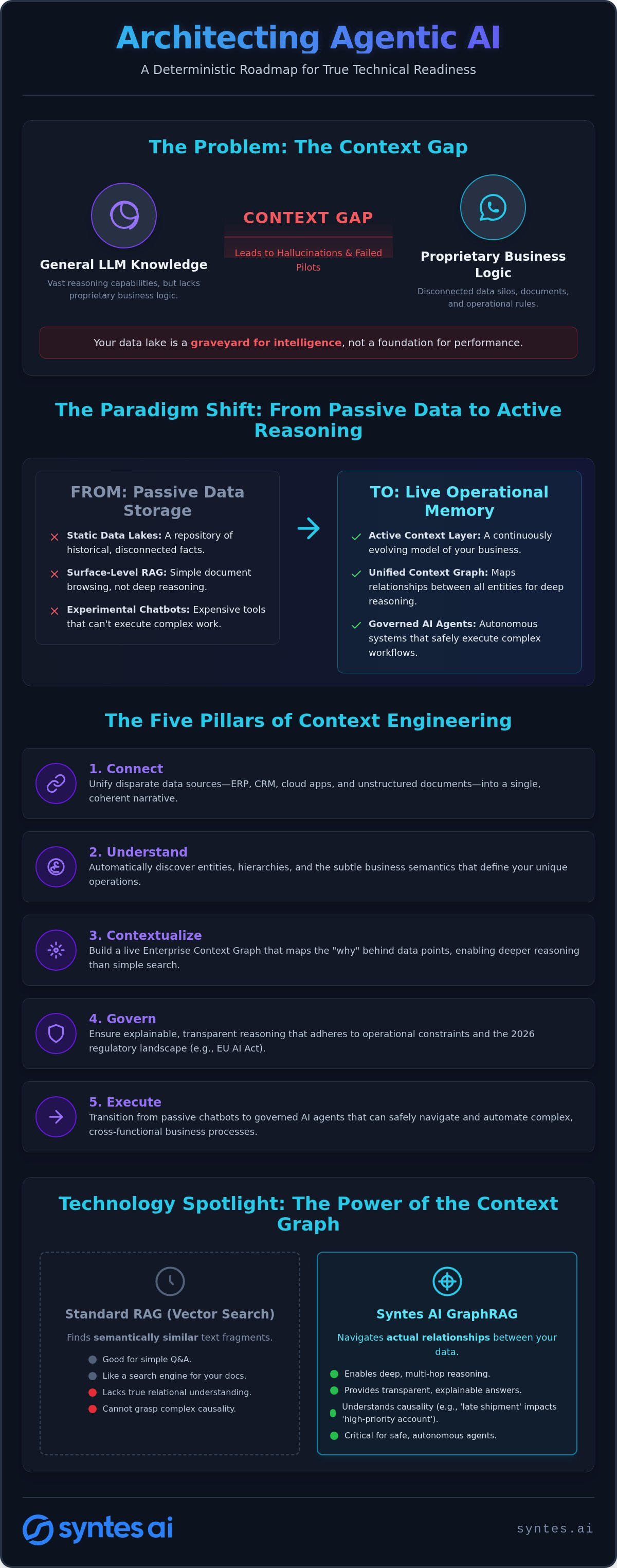
Your data lake is a graveyard for intelligence, not a foundation for performance. Most organizations mistake massive storage for technical readiness for AI implementation, yet they remain paralyzed by hallucinations and disconnected silos. It’s a fatal strategic error. You’ve likely centralized your data, but your generative models still lack the proprietary business context required for precision. You feel the urgency to deploy autonomous agents; however, the risk of unguided execution is too high to ignore.
We’re moving beyond the surface-level checklists of the early 2020s. This article provides a deterministic roadmap to architecting a live operational context layer that powers trusted, agentic AI. You’ll learn how to transition from passive data retrieval to a unified context graph that supports explainable reasoning. We’ll examine the infrastructure required to satisfy the 2026 regulatory landscape, including the EU AI Act, while shifting your architecture from black box experimentation to active, automated performance.
Key Takeaways
- Understand why traditional data lakes fail to support agentic reasoning and how to bridge the “Context Gap” between general LLM knowledge and proprietary business logic.
- Establish a deterministic roadmap for technical readiness for ai implementation by shifting from passive data storage to an active, unified context layer.
- Discover the five pillars of context engineering-Connect, Understand, Contextualize, Govern, and Execute-to ensure your AI infrastructure supports explainable reasoning.
- Learn how to conduct a comprehensive Context Audit to identify where your systems lack the operational memory required for autonomous AI execution.
- Transition from experimental chatbots to governed AI agents that can safely navigate and automate complex business processes across your entire enterprise stack.
The Fallacy of “Data-First” Readiness: Why Your AI Pilot is Stalling
Data lakes are where intelligence goes to die. Most CIOs assume that a pristine data warehouse is the final milestone for technical readiness for ai implementation. This is a dangerous misconception. Clean data is merely a prerequisite, not a strategy for autonomous execution. When Large Language Models (LLMs) lack the specific business logic that governs your unique operations, they produce hallucinations. They don’t just get it wrong; they confidently invent a reality that doesn’t exist within your organization.
The Limitations of First-Wave Enterprise AI
Consider the limitations of Retrieval-Augmented Generation (RAG). It was a temporary bridge that allowed models to browse documents. But browsing is not reasoning. Disconnected PDFs and isolated data points provide facts without the connective tissue of intent. If an AI agent cannot map the relationship between a service level agreement in your legal database and a real-time outage in your ops center, it’s useless. Data silos are more than just an architectural annoyance; they’re a hard ceiling on AI performance. They prevent agents from completing cross-functional workflows, leaving you with expensive chatbots that can’t actually work.
From Passive Data to Active Context
We are witnessing a mandatory shift toward Context Engineering. This discipline focuses on building environments where Artificial intelligence (AI) operates with full visibility into your operational constraints. It’s the evolution from passive information retrieval to active operational reasoning. Your systems must move beyond static data quality to dynamic, relationship-based intelligence. Your AI’s utility is strictly limited by the context it understands. Without a unified context layer, you’re merely funding an expensive experiment in high-speed guesswork. The hidden cost of fragmented data isn’t just storage; it’s the mounting technical debt of every failed pilot project that couldn’t scale. Success requires a live operational memory that bridges the gap between general model knowledge and proprietary business reality.
Architecting for Agentic Intelligence: The Shift to Live Operational Memory
Static data is a liability. It anchors your agents to the past while your business moves at the speed of real-time transactions. Achieving true technical readiness for ai implementation requires more than a clean database; it demands a Live Operational Memory. This is not a snapshot of your organization. It is a continuously evolving digital model that synchronizes your ERP, CRM, and cloud applications into a single, coherent narrative. Without this layer, your AI is operating in a vacuum, forced to guess the intent behind fragmented records.
General Large Language Models (LLMs) possess vast reasoning capabilities, but they lack your specific operational facts. The Department of Energy explains Artificial Intelligence as a system capable of performing human-like tasks, yet in a corporate setting, these tasks require deep context. Relationship-based intelligence replaces the “black box” of traditional AI by providing a transparent map of how entities interact. This transparency is the difference between an AI that makes a guess and one that makes a decision based on enterprise-wide truth.
The Role of the Enterprise Context Graph
Connecting structured data from SQL databases with unstructured insights from emails and contracts is a monumental task. The Syntes AI Context Graph solves this by creating a live map of customers, products, and transactions. We use GraphRAG to provide deeper reasoning capabilities than standard vector search. While vector search finds similar text, GraphRAG navigates the actual relationships between your data points. It understands that a “late shipment” in your logistics system is directly tied to a “high-priority account” in your CRM. You can explore this architecture in a live environment to see how it resolves complex queries.
Operational Relationship Intelligence
Autonomous agents must understand the “why” behind data points to execute workflows safely. Our platform automatically discovers entities, hierarchies, and business semantics across your stack. It identifies the subtle logic that defines your operations, such as how a discount threshold affects gross margin in real-time. This level of insight is critical for agentic workflows that require multi-step reasoning across different departments. Live Operational Memory is the foundation for trusted AI, serving as the definitive, real-time bridge between general reasoning and proprietary business logic.
The Five Pillars of Technical Readiness for AI Implementation
Generic checklists for AI readiness focus on workforce training or basic data hygiene. They miss the mark. True technical readiness for ai implementation is defined by the ability to move from observation to autonomous execution. We’ve established that data lakes are insufficient; now we must architect for performance. Our framework prioritizes the systemic integration of five critical pillars: Connect, Understand, Contextualize, Govern, and Execute. This structure ensures that every AI action is explainable, auditable, and aligned with core business KPIs.
Connect, Understand, and Contextualize
Connectivity is the first point of failure. Most enterprises rely on one-way data ingestion that creates lag and inconsistency. We mandate two-way connectors that link structured business rules with unstructured documents in real-time. This creates a semantic layer, a translation engine that unifies disparate data sources into a single language. By building a Context Graph, you transform these connections into a dynamic enterprise memory. This is the evolution beyond standard RAG. While others struggle with vector similarity, you’re leveraging a navigable map of your organization’s logic, enabling deeper reasoning for complex queries.
Govern and Execute
Governance is not a roadblock; it’s an accelerator. You cannot deploy autonomous agents without a robust framework for security and permissions. We apply granular compliance rules directly to AI agent workflows, ensuring they operate within the same boundaries as your most trusted employees. This includes Human-in-the-Loop systems for high-stakes decisions, where the AI provides the reasoning and a human provides the final authorization. The final pillar, Execute, is where most pilots fail. Architecting for execution means your AI isn’t just generating text; it’s interacting with APIs and automating business processes safely. This is the shift from passive observation to active operational intelligence, turning your technical stack into an engine for measurable performance.
Conducting a Context Audit: A Checklist for AI Readiness
Technical readiness for ai implementation is not a one-time approval. It is a rigorous interrogation of your infrastructure’s ability to support autonomous reasoning. Most audits focus on volume and variety; they ignore context. You must identify “Context Gaps” where your AI lacks the necessary logic to perform tasks. This involves mapping your data’s journey through various silos to see where the narrative breaks. If your AI cannot explain why a specific action was taken, your architecture has failed. You aren’t just checking boxes; you’re building a foundation for trusted execution.
Evaluating Data Connectivity and Semantics
Do your systems talk to each other, or are you relying on manual data exports? Manual exports are a sign of systemic failure in the AI era. You must assess the maturity of your Master Data Management (MDM) for AI grounding. However, MDM alone is insufficient. You must determine if your data is relationship-ready or just record-ready. A record tells you a customer bought a product. A relationship tells you why they bought it, despite a previous support ticket. Record-ready data is passive. Relationship-ready data is active and navigable. This is the baseline for technical readiness for ai implementation.
Preparing for Agentic Workflows
Identifying high-value operational tasks suitable for AI agent automation is the first step toward ROI. You must test your systems for explainable reasoning. If an agent executes a refund or reorders stock, can you audit the AI’s logic? Without this transparency, you’re operating a black box with zero accountability. Your organization must also evaluate its capacity for real-time operational event processing. AI agents cannot wait for overnight batch updates. They require a live stream of business events to make informed decisions. Mapping existing business rules to AI governance frameworks ensures that every automated action adheres to corporate policy and legal mandates. This audit determines if you are building a simple tool or a sophisticated engine for autonomous performance.
Future-Proofing Execution with the Syntes AI Enterprise Platform
Fragmented knowledge is the enemy of scale. Most enterprises remain trapped in a cycle of pilot projects that fail to move beyond the chatbot stage because they lack a unified architectural foundation. The Syntes AI Enterprise Platform resolves this by transforming disconnected data into a live Context Graph. This is the definitive shift from passive storage to active operational intelligence. By owning your enterprise context layer, you ensure that technical readiness for ai implementation is a permanent asset rather than a fleeting state. We provide the infrastructure to scale AI initiatives without compromising on trust, safety, or accuracy. You don’t need more data; you need more meaning.
Trusted AI through Context Engineering
Hallucinations are not an inherent flaw of AI; they are the symptoms of a context vacuum. We eliminate this uncertainty by providing a deterministic ground truth for LLMs. Leveraging the Syntes Context Engineering Framework, organizations can move from connectivity to execution with unprecedented speed. This framework integrates live operational memory directly into your existing software stack, ensuring that every agent operates with full visibility into your business rules. It’s about building a system that doesn’t just talk, but performs. By anchoring your AI in an Enterprise Knowledge Graph, you provide the explainable reasoning required for high-stakes enterprise decisions. This is how you bridge the gap between general reasoning and proprietary operational facts.
The Path to Enterprise Intelligence
Why settle for prompt engineering when you can architect context? Prompting is a fragile, surface-level fix for a systemic problem. The next evolution of AI requires a fundamental shift to context engineering. This approach establishes a unified context layer for all enterprise AI applications, allowing you to deploy governed AI agents via the Syntes Agentic Platform. These agents are capable of executing complex business processes across departments with total precision. It is time to stop experimenting with isolated tools and start building a resilient enterprise memory. The strategic advantage in 2026 belongs to those who control their operational context. You must move beyond the black box and toward a state of total operational clarity. Start building your live operational memory today-schedule your demo here.
Transitioning from Data Readiness to Operational Execution
The era of passive data storage is over. Organizations that don’t transition from volume-based storage to relationship-based intelligence will remain trapped in a cycle of failed pilots and mounting technical debt. True technical readiness for ai implementation in 2026 requires a fundamental shift toward architecting a live operational context layer. By leveraging the Syntes AI Context Graph, you move beyond the limitations of standard RAG to create a living operational model that provides deterministic ground truth for every automated action. This is the foundation of governed agentic AI, where trusted enterprise execution is a systemic reality rather than a theoretical goal.
Context Engineering is the next evolution in the AI stack. It bridges the gap between general reasoning and proprietary business logic, transforming fragmented records into an active, navigable memory. You now possess the roadmap to evaluate your infrastructure and close critical context gaps. The choice is clear: remain paralyzed by disconnected silos or architect a system designed for autonomous performance.
The path to total operational clarity is open to those bold enough to claim it.
Frequently Asked Questions
What is technical readiness for AI implementation in 2026?
Technical readiness for ai implementation in 2026 is the transition from passive data storage to an active, unified context layer. It requires an infrastructure that supports explainable reasoning and autonomous agent execution. Organizations must move beyond basic data hygiene to architect a live operational memory. This foundation ensures that AI systems understand proprietary business logic, shifting the focus from simple information retrieval to complex, governed decision-making across the entire enterprise software stack.
How does Context Engineering differ from traditional data engineering?
Traditional data engineering focuses on the ingestion and storage of isolated records within databases. Context Engineering is the next evolution, prioritizing the discovery of entities, relationships, hierarchies, and business semantics. It builds a navigable map of how data points interact across disparate systems. While data engineering provides the raw materials, Context Engineering creates the enterprise memory required for AI agents to understand the “why” behind every transaction and operational event.
Why is a Knowledge Graph essential for enterprise AI readiness?
A Knowledge Graph serves as the definitive bridge between general Large Language Model knowledge and proprietary operational facts. It organizes structured and unstructured data into a navigable web of relationships rather than disconnected silos. This structure is essential for GraphRAG, which provides deeper reasoning capabilities than standard vector search. By using a Knowledge Graph, enterprises ensure their AI operates from a shared, deterministic ground truth that reflects the realities of large-scale operations.
Can we implement AI if our data is still stored in legacy silos?
You can deploy advanced AI without a complete legacy overhaul by implementing a unified context layer. Syntes AI uses two-way connectors to link fragmented data from ERP, CRM, and cloud applications into a live Context Graph. This approach allows organizations to achieve technical readiness for ai implementation by creating a semantic layer that unifies disparate sources. It transforms static records into relationship-ready intelligence without requiring expensive and time-consuming data migration projects.
What are the main security considerations for deploying agentic AI?
Deploying agentic AI requires a robust governance framework that applies granular security and permissions to automated workflows. Agents must operate within the same compliance boundaries as human employees, ensuring every action is authorized and auditable. Security considerations include managing cross-system access, preventing unauthorized data exfiltration, and implementing Human-in-the-Loop systems for high-stakes decisions. A governed context layer ensures that autonomous agents remain transparent and fully aligned with corporate risk policies.
How do we prevent AI hallucinations in a production environment?
Preventing hallucinations requires anchoring language models in a deterministic ground truth. AI systems often invent facts when they lack the specific business context required for a task. By providing a live Context Graph, you supply the model with actual relationships and business rules rather than just raw text. This shift from prompt engineering to Context Engineering ensures that AI reasoning is based on verifiable enterprise data, resulting in trusted, explainable outcomes in production environments.
What is the ROI of investing in a live operational context graph?
The ROI of a live operational context graph is found in the transition from experimental pilots to production-ready automation. Organizations see immediate value through reduced hallucination rates and the ability to deploy governed AI agents that execute complex workflows. By creating a unified enterprise memory, you eliminate the technical debt associated with fragmented knowledge. This infrastructure supports faster decision-making, higher accuracy in automated processes, and the ability to scale AI initiatives across multiple departments.
How long does it take to achieve technical readiness for AI?
Achieving technical readiness is a strategic progression rather than a single event. While foundational data hygiene can take months, implementing a specialized context layer using the Syntes Context Engineering Framework allows for rapid acceleration. Most enterprises can establish a functional Context Graph and begin deploying governed agents within a few months. The timeline depends on the maturity of existing integrations and the specific operational tasks prioritized for automation, focusing on high-value workflows first.