
How do you bridge the gap between experimental AI and secure, production-ready intelligence? The answer is semantic grounding. This article provides the blueprint for architecting deterministic truth, showing you how to eliminate model hallucinations and gain full visibility into AI agent actions. You’ll discover how to move beyond the copilot model toward a future of high-stakes execution that respects the gravity of your enterprise data. We’re moving from passive observation to active, automated performance with total operational clarity.
Key Takeaways
- Define the fundamental architecture of secure enterprise ai by merging autonomous intelligence with deterministic data governance to meet strict corporate compliance mandates.
- Transition from unreliable vector-only retrieval to graph-enhanced grounding, using an Enterprise Knowledge Graph to provide a permanent semantic layer for AI accuracy.
- Address the security vulnerabilities inherent in agentic AI platforms that execute tasks across systems, moving beyond the limitations of legacy RPA security models.
- Implement a 5-step strategic roadmap designed for 2026 to scale from experimental AI prototypes to fully integrated, production-ready systems.
- Leverage cross-system integrations and agentic infrastructure to achieve total operational clarity and eliminate model hallucinations in high-stakes business environments.
The Security Gap: Why Consumer AI Fails the Enterprise Mandate
Consumer AI is a liability. It prioritizes creative fluency over operational accuracy, creating a fundamental mismatch with the rigors of global commerce. Secure enterprise ai is not merely a “protected” version of a public chatbot; it is the deliberate fusion of autonomous intelligence with deterministic data governance. While consumer models operate as opaque “black boxes,” enterprise-grade systems require total transparency to meet the demands of modern corporate compliance. To move from experimental pilots to production, organizations must embrace Explainable AI (XAI). This framework ensures that every decision made by an agent can be traced, audited, and justified. Security is not a bolt-on feature. It is a fundamental architectural requirement. Without it, your systems are vulnerable to data leakage, prompt injection, and the persistent threat of hallucinations.
The Risk of Non-Deterministic Intelligence
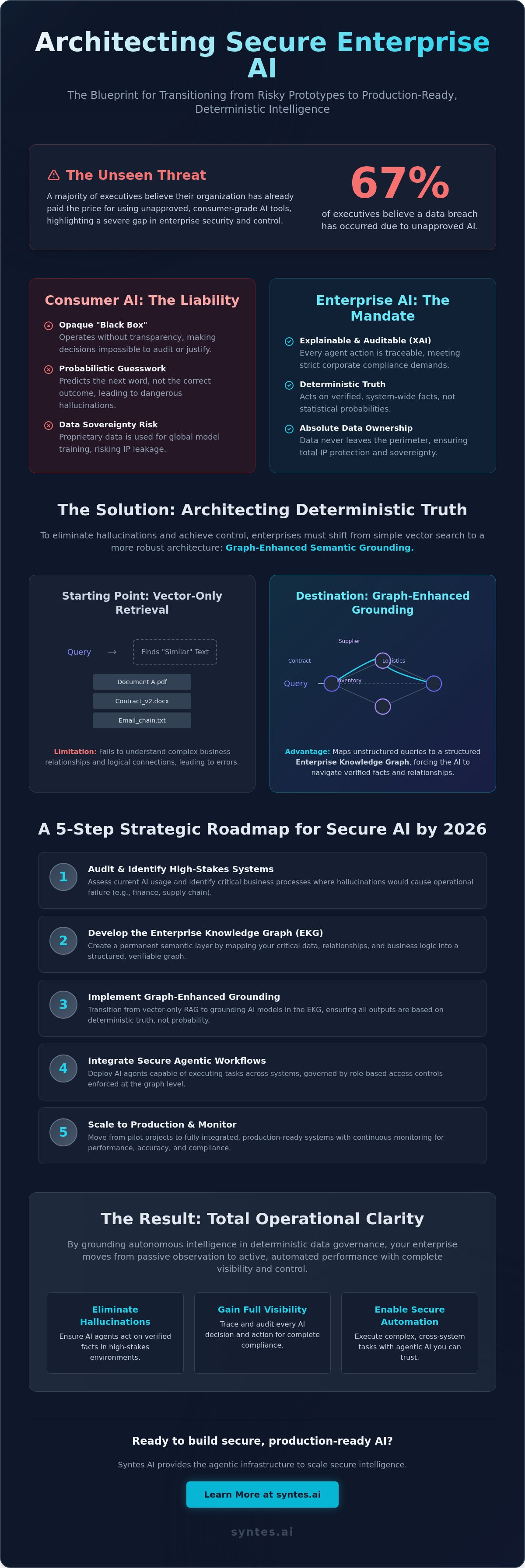
Why are probabilistic models insufficient for high-stakes tasks? They predict the next word, not the correct outcome. In supply chain management or financial reporting, a “near-miss” is a total failure. Hallucination-driven errors aren’t just inconveniences; they are operational catastrophes that erode market cap and stakeholder trust. As of June 2026, 67% of executives believe their company has already suffered a data breach due to unapproved AI tools. This highlights the gravity of the problem. Ground truth is the only antidote. It replaces “best guesses” with verified, system-wide facts, ensuring that your AI agents act on reality rather than statistical probability.
Data Sovereignty vs. Public Model Training
Your proprietary IP is your competitive advantage. Yet, using public LLMs often means donating that IP to a global training set. Data sovereignty is the new enterprise mandate. It requires isolated, private inference environments where data never leaves the perimeter. The regulatory environment is tightening. The Transparency in Frontier AI Act (SB 53) became effective on January 1, 2026, and the Great American AI Act discussion draft was released on June 4, 2026. These laws demand a level of data control that consumer tools simply cannot provide. Secure enterprise ai requires a shift toward architectures where data ownership is absolute and public model training is strictly prohibited.
Architecting Deterministic Truth: The Role of Enterprise Knowledge Graphs
Security is not a perimeter; it’s a foundation. Most organizations mistakenly treat secure enterprise ai as a series of reactive filters. They’re wrong. Filters are superficial. Architecture is definitive. To achieve deterministic truth, you must move beyond the probabilistic nature of Large Language Models. You need a semantic layer that enforces logic. This is the role of the Enterprise Knowledge Graph. It provides a structured map of your business reality that an LLM cannot ignore. It anchors the model in facts, ensuring that every output is grounded in your specific operational reality.
Semantic Grounding: Beyond Simple Vector Search
Vector databases are a starting point, not a destination. They excel at finding similar text but fail at understanding complex business relationships. If you ask a vector-only system about a specific contract’s impact on a global supply chain, it might find the right document but miss the logical connection to your inventory. knowledge graph for llm grounding is the process of mapping unstructured queries to structured, verified data nodes. By grounding the AI in a graph, you force it to navigate a web of verified relationships. This eliminates the “black box” guesswork. It replaces probability with certainty. This transition from basic RAG to graph-enhanced retrieval is the only way to prevent AI hallucination in high-stakes enterprise environments.
Enforcing Role-Based Access at the Graph Level
Governance must be baked into the data layer. Traditional security models often fail when AI agents start traversing disparate systems. A knowledge graph solves this by mirroring your existing enterprise permission structures. It acts as a centralized gatekeeper. When a user queries the system, the graph filters the available data nodes based on that user’s specific security clearance. This ensures that the AI never processes or retrieves information it shouldn’t. It’s a “Security-by-Design” approach that aligns with the NIST AI Risk Management Framework. This isn’t just about blocking access. It’s about ensuring that every action an agent takes is compliant and visible.
Achieving this level of precision requires a shift in how you view your data environment. It’s time to stop experimenting with isolated tools and start building a unified intelligence layer. You can explore how to integrate these semantic structures with the Syntes Enterprise Knowledge Graph to ensure your operations remain both intelligent and protected. By prioritizing grounding over simple retrieval, you turn AI from a risky experiment into a reliable strategic asset.
Governing the Machine: Securing Agentic Workflows and Integrations
The transition from passive information retrieval to autonomous execution marks the true beginning of the agentic era. It also introduces a volatile new attack surface. While previous sections detailed the need for semantic grounding, the focus now shifts to the agents themselves. These are no longer just chatbots; they are active entities capable of triggering API calls, modifying database records, and navigating complex software stacks. Secure enterprise ai requires more than just a locked-down LLM. It demands a governance layer that can keep pace with the non-linear, dynamic nature of autonomous workflows. Organizations must move beyond reactive measures and adopt the NIST AI Risk Management Framework to govern these dynamic entities. Without this, you’re essentially handing the keys to your ERP and CRM systems to a black box.
Why does traditional RPA security fail here? Robotic Process Automation relies on static, “if-this-then-that” logic. You know exactly what an RPA bot will do because you programmed every step. AI agents are different. They are goal-oriented, meaning they determine their own path to an outcome. This autonomy creates the risk of unintended privilege escalation or catastrophic API sequences that no human developer explicitly authorized. For high-impact actions, a “Human-in-the-Loop” (HITL) model is the only responsible path forward. It ensures that while the machine handles the labor, the human retains the final authority over execution.
The Agentic Security Framework
Securing an agent requires three non-negotiable pillars: authentication, authorization, and auditability. The agent must prove its identity to every system it touches, just like a human employee. It must only have access to the specific data nodes required for its current task. Finally, every step of its reasoning and execution must be logged for forensic review. This is why ai model reliability is not a separate IT concern; it is the bedrock of a secure enterprise ai strategy. If a model isn’t reliable, it isn’t secure. Monitoring agent intent is the only way to prevent malicious or accidental system damage before it occurs.
Securing Cross-System Integrations
The danger of “Agent Sprawl” is real. As agents proliferate across your ERP, CRM, and legacy systems, the complexity of managing their permissions grows exponentially. You must implement “least privilege” access at the API level. An agent tasked with summarizing sales reports doesn’t need write-access to your financial ledger. Middleware plays a critical role here. It acts as a protective buffer, sanitizing agent outputs and validating requests before they reach your core systems. This architectural separation ensures that even if an agent’s logic deviates, your underlying infrastructure remains protected. It’s about building a system where intelligence and safety coexist without compromise.
A Strategic Roadmap for Secure AI Implementation in 2026
The era of AI experimentation is over. As organizations move from isolated pilots to full-scale production, the stakes for secure enterprise ai have never been higher. Success in 2026 requires a rigorous, architectural approach. You cannot simply layer security on top of a flawed system. You must build it into the core. This roadmap provides a 5-step framework to transition from fragile prototypes to resilient, production-grade intelligence that delivers measurable ROI. It’s a journey from fragmented data to total operational clarity.
Step 1: Unifying the Data Foundation
Fragmented data silos are a security liability. If your AI cannot access a unified, verified source of truth, it will fill the gaps with hallucinations. Breaking down these silos is the prerequisite for any secure initiative. This begins with robust ai data quality management. AI data quality management is the systematic process of ensuring data is accurate, complete, and contextually relevant for model grounding. Without this foundation, your semantic layer is built on sand. You must consolidate your cross-system data into a single, accessible environment where relationships are clearly defined and governed.
Step 2: Implementing Zero-Trust AI Architecture
Apply the principle of “never trust, always verify” to every model interaction. In a zero-trust environment, an agent’s request is never assumed to be safe simply because it originated internally. Every API call, every data retrieval, and every system modification must be authenticated in real-time. This is the cornerstone of a modern secure enterprise ai strategy. Use secure enclaves to protect sensitive data during the inference process. Encryption is mandatory. By isolating the inference environment, you ensure that even if a model is compromised, your underlying data remains inaccessible to unauthorized entities.
The remaining steps of the framework focus on operationalizing this security. Step 3 involves the semantic grounding we’ve discussed, ensuring deterministic truth through a knowledge graph. Step 4 requires continuous monitoring of model drift and security posture. Models degrade. Their logic can shift, creating new vulnerabilities that require immediate remediation. A critical component of Step 4 is understanding how to prevent AI hallucination through structured knowledge graph grounding rather than relying on probabilistic retrieval alone. Finally, Step 5 demands a centralized AI orchestration platform. This platform unifies your governance policies, providing a single pane of glass for all agentic actions across the enterprise. You can begin this transition today by deploying the Syntes Agentic Platform to orchestrate your secure workflows with absolute precision.
Syntes AI: Scaling Secure Intelligence Through Agentic Infrastructure
The strategic roadmap for 2026 is clear, but successful execution requires a platform built specifically for the complexities of the modern global corporation. Syntes AI delivers this through an infrastructure that prioritizes systemic integration over isolated experimentation. The Syntes AI Agentic Platform serves as the definitive solution for secure enterprise ai, enabling organizations to automate cross-system workflows without sacrificing data sovereignty. By utilizing the Syntes AI Enterprise Knowledge Graph, the platform provides the deterministic grounding necessary to turn autonomous agents into reliable business assets. This is the final step in moving from passive observation to a state of active, automated performance where every model output is verified against your internal reality.
The Syntes AI Advantage: Security by Architecture
The architecture within Syntes AI unifies both structured and unstructured data into a single, governed semantic layer. This isn’t a bolt-on security filter. It is a foundation that manages agentic permissions at scale, mirroring your existing enterprise security protocols within the AI execution layer. Unlike fragmented, consumer-grade tools that offer no visibility, Syntes AI provides full auditability of every agent action and reasoning step. The ROI of this approach is measured in the elimination of hallucination-driven errors and the reduction of compliance risks that plague standard LLM deployments. You gain a level of operational intelligence that simple chatbots cannot match, ensuring that your AI strategy is focused on high-stakes execution rather than theoretical play.
Next Steps for the AI-Ready Enterprise
Your immediate priority is a strategic audit of existing AI “Shadow” tools to identify hidden vulnerabilities within your department stacks. Once these risks are mitigated, the transition to a production-grade environment begins with mapping your internal data silos into a semantic knowledge graph. Syntes AI consultants specialize in this architectural transition, ensuring your data is contextually relevant for model grounding and cross-system automation. Don’t let your AI strategy remain a series of disconnected pilots that fail to deliver measurable value. Lead your organization toward total operational clarity by deploying the engine of the agentic era. The transition from experimentation to production is a mandate for survival.
Explore the Syntes Agentic Platform and start architecting your secure intelligence layer today.
The Mandate for Deterministic Intelligence in the Agentic Era
The window for experimental AI has closed. You’ve seen why consumer-grade models fail the enterprise mandate and how semantic grounding through knowledge graphs provides the only path to deterministic truth. Architecting secure enterprise ai is no longer a strategic luxury; it’s a fundamental requirement for operational survival. You must move from passive observation to active, automated performance with total clarity. Fragmented data silos and probabilistic guesses are liabilities you can’t afford.
Syntes AI stands as the definitive partner in this transition. Founded by experts in enterprise systems architecture, our infrastructure provides the Enterprise Knowledge Graph foundation necessary for absolute data integrity. We deliver an agentic platform specifically engineered for cross-system operational intelligence, allowing you to govern autonomous actions with surgical precision. Stop managing risk through reactive filters and start building on a foundation of architectural certainty. The future of your enterprise depends on the quality of your grounding.
Architect your secure AI future with Syntes AI. The era of certain, scalable intelligence is here, and it’s time to lead with conviction.
Frequently Asked Questions
What is the difference between secure enterprise AI and standard AI?
Standard AI relies on probabilistic next-token prediction using public or unverified datasets. Secure enterprise ai integrates autonomous intelligence with deterministic data governance. It ensures that every output is grounded in your proprietary IP and executed within a private, isolated environment. This architecture prevents data leakage and ensures compliance with global regulations like the GAAIA and GDPR.
Can secure enterprise AI prevent all hallucinations?
Hallucinations are effectively eliminated through semantic grounding. By mapping unstructured queries to structured, verified data nodes, the system replaces statistical probability with factual certainty. While a raw LLM might guess an answer, a grounded system verifies the request against an Enterprise Knowledge Graph. This ensures that the agent only acts on “ground truth” rather than hallucinated logic.
How does a knowledge graph improve AI security?
A knowledge graph functions as the semantic foundation for access control. It mirrors your existing enterprise permission structures at the data level. When an AI agent attempts to retrieve information, the graph filters the available nodes based on the user’s specific security clearance. This centralized governance ensures that data sovereignty is maintained without requiring individual model tuning for every user.
Is it possible to secure AI agents that operate across multiple legacy systems?
Securing agents across legacy stacks is achievable through robust cross-system integrations and protective middleware. This layer acts as a buffer, sanitizing agent outputs and validating API requests before they reach core ERP or CRM systems. By implementing “least privilege” access, you ensure that autonomous agents can navigate outdated infrastructure without triggering unintended system modifications or security breaches.
What are the biggest security risks when deploying agentic AI?
The primary risks include data leakage through public training and unintended privilege escalation during autonomous execution. Agentic AI platforms that move beyond simple chat can trigger complex API sequences that lead to system damage if not governed. Without a “Human-in-the-Loop” model for high-stakes actions, organizations risk losing visibility into how agents interact with critical business logic.
How much does it cost to implement a secure enterprise AI framework?
Implementation costs depend entirely on the volume of data silos and the depth of required system integrations. It’s a strategic investment in infrastructure rather than a simple software purchase. Organizations should evaluate the total cost of ownership against the potential losses from data breaches. Research from 2026 indicates that 59% of companies are investing over $1 million annually in AI technology to bridge this gap.
Does secure AI slow down the speed of innovation?
Secure AI frameworks actually accelerate innovation by removing the operational friction caused by security fears. When leaders have confidence in the deterministic nature of their systems, they move faster from pilot to production. Security provides the guardrails that allow your teams to deploy high-stakes automation without the risk of catastrophic failure. It turns AI into a reliable strategic asset.