
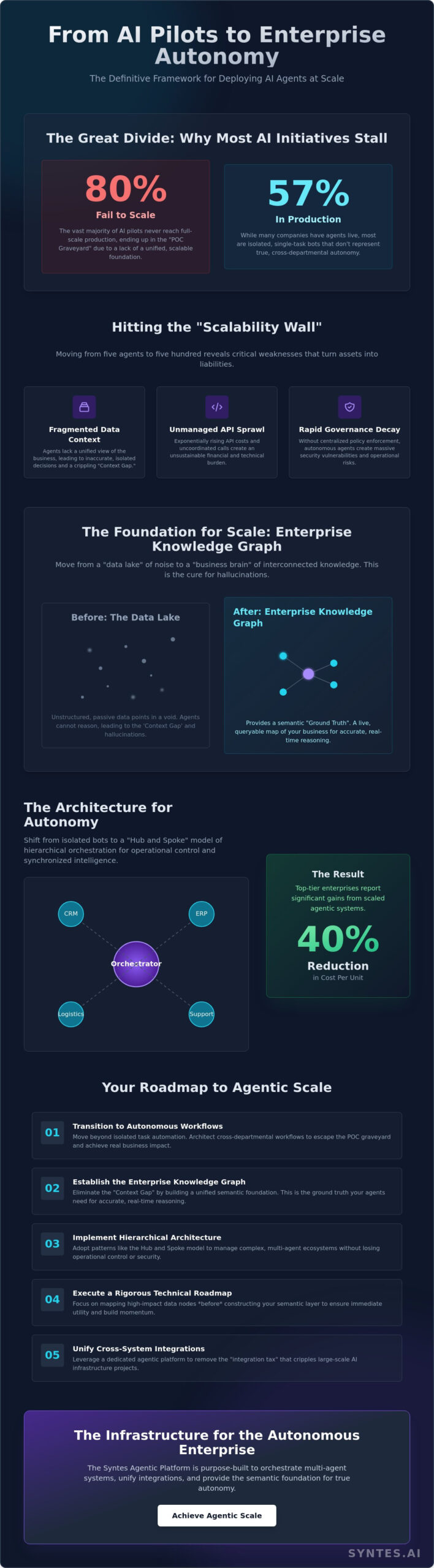
Why do most enterprise AI initiatives stall at the pilot stage while a select few achieve total operational autonomy? The answer isn’t more models. It’s superior orchestration. While 57% of companies have agents in production as of 2025, the majority struggle with fragmented logic and escalating API costs. Success in deploying ai agents at scale requires a fundamental shift from building isolated chatbots to architecting a unified, cross-system infrastructure. You know the “black box” approach is unsustainable. You’re ready to move beyond agents that lack context and systems that fail to communicate.
This article delivers the definitive framework to move your organization from experimental pilots to a robust, agentic reality. You’ll master the technical requirements for semantic connectivity and learn how to secure autonomous access across complex data environments. We’ll explore the transition from stateless agents to sophisticated multi-agent systems that utilize an Enterprise Knowledge Graph for real-time relevance. It’s time to eliminate hallucinations and achieve the 40% reduction in cost per unit that top-tier enterprises are already reporting. We’re moving from passive observation to active, automated performance.
The pilot era is over. While 57% of companies have agents in production as of 2025, many are merely scratching the surface of true operational autonomy. True agentic scale isn’t the deployment of fifty separate chatbots. It’s the transition to cross-departmental autonomous workflows where an intelligent agent can navigate complex business logic without constant human hand-holding. Most organizations currently reside in the “POC Graveyard.” Industry reports suggest that roughly 80% of AI pilots fail to reach full-scale production. They fail because they lack a unified semantic foundation. They’re built as silos in an environment that demands connectivity.
Deploying ai agents at scale reveals the “Scalability Wall” almost immediately. This wall consists of fragmented data context, unmanaged API sprawl, and rapid governance decay. When you move from five agents to five hundred, the cost of uncoordinated API calls and the risk of hallucination grow exponentially. You don’t need more “wrappers” around large language models. You need systemic orchestration that treats AI as a core component of your enterprise architecture. The goal is moving from passive observation to active, automated performance across the entire stack.
Consumer-grade “wrapped” LLMs crumble under the weight of complex business logic. They rely on manual prompt engineering, which is impossible to maintain at a massive scale. These tools lack the deep integration required to understand your specific operational nuances. Security is the second casualty. Without centralized policy enforcement, agents operating autonomously create massive vulnerabilities in your data perimeter. They become liabilities rather than assets when they lack a controlled environment for execution.
The future belongs to hierarchical orchestration. Single-task bots are being replaced by multi-agent systems where specialized agents interact with legacy ERP and CRM systems. This isn’t simple Retrieval-Augmented Generation (RAG). It’s active, cross-system execution. Successful deploying ai agents at scale requires these agents to communicate through a shared intelligence layer. When a change occurs in your supply chain, your agents must trigger an immediate, informed response in customer service and logistics simultaneously. This level of synchronization requires a fundamental shift in how you perceive agentic roles.
The data lake is dead. For years, enterprises poured petabytes of unstructured information into central repositories, hoping for insight. They found noise instead. When deploying ai agents at scale, this lack of structure becomes a fatal flaw. Agents cannot reason across a void. They require a semantic framework that defines relationships, hierarchies, and business logic. Without it, your agents operate in a vacuum, leading to the ‘Context Gap’ where probabilistic models are forced to fill in the blanks with hallucinations. The solution is the transition from static, isolated data points to an interconnected, actionable Enterprise Knowledge Graph. This foundation converts passive data into a live, queryable map of your business.
Why settle for a system that guesses when you can have one that knows? A semantic layer provides the definitive ‘Ground Truth’ for your agentic ecosystem. It transforms raw data into knowledge nodes that represent real-world entities: products, customers, transactions, and policies. By mapping these nodes, you create a deterministic roadmap for probabilistic LLMs. This isn’t just about storage; it’s about moving toward a state of total operational clarity where every autonomous action is backed by verified data. You aren’t just giving an agent access to a database. You’re giving it a brain.
Semantic grounding is the process of anchoring agent responses in structured facts. It eliminates the ‘black box’ problem by forcing the model to follow specific logic paths defined within the graph. This creates an immediate audit trail. You can see exactly why an agent made a decision because that decision is tied to a specific node of truth. For high-stakes enterprise environments, this reliability isn’t a luxury. It’s a prerequisite for production.
Fragmentation is the enemy of autonomy. Most agents fail because they can’t see the full picture. They might access Salesforce but remain blind to SAP, legacy databases, or internal wikis. Semantic data unification breaks these silos by mapping disparate sources into a single, cohesive graph. By applying a consistent ontology, agents understand business-specific terminology across all platforms. They don’t just ‘see’ data; they comprehend the underlying intent. This unified interface allows for seamless execution, enabling you to integrate cross-system intelligence directly into your core workflows, ensuring that every agent has the context required to act with precision.
Architecture is the engine of autonomy. Most enterprises fail because they treat agent deployment as a series of disconnected projects rather than a unified systemic evolution. When deploying ai agents at scale, your structural blueprint determines whether your system thrives or collapses under its own complexity. You don’t need a collection of bots. You need a coordinated ecosystem designed for high-register execution and operational intelligence. Success requires moving beyond simple scripts toward sophisticated patterns that manage state, hierarchy, and cross-system communication.
The ‘Hub and Spoke’ model serves as the primary standard for high-compliance environments. In this pattern, a central orchestration brain manages specialized edge agents. It ensures that every action aligns with corporate policy while allowing edge agents to execute niche tasks with high precision. For even greater complexity, hierarchical agent frameworks allow for delegation. One manager agent oversees multiple worker agents, distilling high-level objectives into granular, executable steps. This mimics enterprise management structures, providing a familiar yet automated way to handle massive workloads. Additionally, the ‘Digital Twin’ pattern allows agents to represent specific business entities, such as a supply chain node or a customer profile, providing a persistent, agentic interface for real-time process management.
State management remains the ultimate bottleneck for large-scale operations. If an agent forgets context mid-workflow, the entire process fails. Solving this requires persistent memory layers that ensure agents remember interactions across long-running, multi-day workflows. It’s about maintaining a continuous thread of logic in a fragmented data environment.
Central orchestration is mandatory for high-compliance tasks. It provides a deterministic path where every move is logged and controlled. Conversely, decentralized choreography is better for flexible, creative workflows where agents need the freedom to adapt to changing inputs. The challenge lies in balancing this autonomy with deterministic guardrails. You must decide where the “human in the loop” is necessary and where the system can act with total independence. It’s a strategic choice between absolute control and maximum agility.
A resilient network requires an ‘Agentic Mesh’ where agents can discover and call each other without manual intervention. This requires standardizing protocols for agent-to-agent communication through semantic APIs. By utilizing localized graph processing, you reduce latency and ensure that agents have immediate access to relevant data nodes. This mesh ensures that deploying ai agents at scale doesn’t result in a sluggish, centralized bottleneck, but rather a fast-paced, interconnected web of operational capability.
Stop treating AI as a series of experimental pilots. It’s an engineering discipline. Moving from a single proof-of-concept to a massive, interconnected ecosystem requires a methodical, step-by-step approach that prioritizes systemic integrity over isolated performance. If you want to succeed in deploying ai agents at scale, you must follow a blueprint that accounts for the messy realities of enterprise data. This is how you build a resilient, autonomous operation that actually delivers ROI.
Execution is everything. You can’t afford to let your agentic strategy stall at the integration phase. To see how a unified infrastructure can accelerate your deployment, explore the Syntes Agentic Platform.
Autonomous agents require a clear legal and operational identity. You must establish Role-Based Access Control (RBAC) specifically designed for non-human entities. Define strict boundaries on financial and operational execution; for example, an agent might have the authority to process a refund up to $500 but must escalate anything higher. Every agent needs a unique digital identity that can be audited, restricted, or revoked instantly. This isn’t just about security. It’s about accountability in a decentralized system.
Visibility is the antidote to chaos. When deploying ai agents at scale, you need real-time logging for every thought process and action. You don’t just want to see the output; you need to see the reasoning path. Implement automated ‘Kill-Switches’ that trigger if an agent exhibits anomalous behavior or exceeds its prescribed latency. Continuous evaluation loops are mandatory to detect performance drift. If an agent starts losing accuracy in production, your system must identify and isolate it before it impacts the broader workflow.
The transition from theoretical AI to operational autonomy requires more than just better models. It demands a superior infrastructure. Most organizations hit a ceiling when they realize that their bespoke agentic scripts cannot handle the volatility of enterprise environments. The Syntes Agentic Platform serves as the definitive bridge between your raw data and autonomous action. By deploying ai agents at scale through a centralized platform, you eliminate the “Integration Tax” that typically consumes 80% of development resources. Our integrated Enterprise Knowledge Graph isn’t an add-on; it’s the core engine that ensures every agentic decision is grounded in your specific business logic.
We’ve built a system that moves your performance from “maybe” to “always.” This is enterprise-grade reliability. While others struggle with model drift or prompt degradation, our platform provides a deterministic execution environment. You are no longer at the mercy of probabilistic guesses. You are future-proofed. As new LLM models emerge, your agents adapt without a total rewrite of your underlying business logic. You retain the intelligence; you simply upgrade the engine. This separation of logic from the model layer is the only way to maintain stability in a rapidly evolving technological landscape.
Managing thousands of specialized agents requires a single pane of glass. The Syntes Agentic Platform provides total visibility into every autonomous workflow, ensuring that your decentralized agents remain aligned with centralized policy. Our native integration with the Enterprise Knowledge Graph enables zero-hallucination workflows. We’ve proven this in the most demanding environments, from global supply chain optimization to high-frequency financial reporting. You don’t just deploy; you orchestrate with absolute certainty. This unified approach ensures that deploying ai agents at scale doesn’t lead to governance decay, but rather to systemic operational clarity.
Autonomy is useless without the power to act. Our platform features pre-built Cross-System Integrations for major enterprise ERP and CRM platforms, allowing your agents to execute complex tasks across the entire stack. Every interaction is backed by a full audit trail, providing the transparency required for high-compliance industries. You aren’t just building bots. You’re building a digital workforce that understands its limits and its authority. It’s time to move beyond the pilot and embrace the future of operations. Scale your agentic strategy with Syntes AI today.
The era of experimental AI is closing. Organizations that fail to move beyond fragmented pilots will find themselves trapped in a cycle of escalating technical debt and operational inconsistency. Success in deploying ai agents at scale is no longer a matter of model selection; it’s a matter of semantic connectivity. By integrating an Enterprise Knowledge Graph with a robust agentic platform, you provide your autonomous systems with the ground truth they need to execute complex business logic across SAP, Salesforce, and beyond. You’ve moved from passive observation to active, automated performance.
You’ve seen the roadmap. Now, it’s time to execute. The Syntes Agentic Platform provides the industry-leading semantic grounding technology required for high-compliance enterprise environments. It’s the infrastructure designed to turn raw data into a live, actionable workforce. Don’t wait for the market to dictate your digital evolution. Explore the Syntes Agentic Platform and Knowledge Graph to secure your operational lead. The path to total operational clarity starts with a single, unified foundation. Your autonomous future is ready for deployment.
Chatbots provide information; agents execute outcomes. While a chatbot might interpret a query, an agent at scale interacts with the Enterprise Knowledge Graph to perform multi-step actions across disparate departments. Transitioning to deploying ai agents at scale means moving from a reactive support tool to an active, autonomous participant in your business logic. It’s the difference between merely answering a customer’s question and autonomously resolving their issue across three different backend systems.
They provide a deterministic structure for probabilistic models. By grounding an LLM in an Enterprise Knowledge Graph, you force the system to retrieve facts from a verified semantic layer rather than predicting the next likely word. This ensures that every output is anchored in your organization’s specific ground truth, effectively eliminating the “black box” reasoning problem that plagues smaller pilots. It provides the logical justification for every action taken by the system.
Yes, through specialized Cross-System Integrations. You don’t need to overhaul your existing stack to achieve autonomy. The Syntes Agentic Platform acts as a sophisticated orchestration layer that communicates with legacy databases and modern APIs alike, ensuring that your agents can execute tasks without compromising the integrity of your core records. This allows for a seamless transition where AI enhances your current ERP capabilities instead of forcing a costly and risky migration.
The primary risks involve unauthorized system access and a lack of auditability. Mitigating these requires strict Role-Based Access Control (RBAC) and real-time observability. By assigning unique digital identities to every agent, you can monitor their thought processes and revoke authority instantly if anomalous behavior is detected. This maintains a secure and transparent operational environment where every autonomous action is logged and evaluated against centralized security policies to prevent performance drift.
Focus on median containment rates and cost-per-unit reductions. Beyond the 40% cost reduction often seen in customer service, ROI is found in the acceleration of complex workflows that previously required manual oversight. Measuring the time-to-value is also critical; most enterprises see a meaningful impact within three to six months when deploying ai agents at scale. You should also consider the “integration tax” saved by using a unified platform rather than building fragmented, bespoke solutions.
It is the centralized management of agent hierarchies and communication protocols. Without orchestration, agents operate in silos, leading to logic conflicts and API sprawl. A unified framework ensures that specialized agents discover and call each other efficiently, allowing the system to handle thousands of concurrent tasks while adhering to a single set of governance rules. This structure is essential for maintaining operational clarity and ensuring that autonomous actions don’t result in systemic chaos.
Syntes AI enforces centralized policy controls within the Syntes Agentic Platform to align with global standards like the EU AI Act and the Colorado AI Act. We provide an immutable audit trail for every autonomous action, ensuring that your data remains protected and your operations stay compliant. This high-compliance environment is essential for organizations operating in regulated sectors like finance or healthcare where transparency and data sovereignty are non-negotiable requirements.
No, building a new data lake is often counterproductive. Instead, you should implement a semantic layer that connects your existing silos. An Enterprise Knowledge Graph sits above your current data infrastructure, providing the necessary context and connectivity without the high cost and risk of a massive data migration project. This allows your agents to access real-time information across the entire organization while maintaining the existing security and structure of your current databases.
DataRobot has been instrumental as we work through our generative and predictive AI use cases. With DataRobot’s LLM operations (LLMOps) capabilities and out-of-the-box LLM performance monitoring, we’re equipped to implement cutting-edge generative AI techniques into our business while monitoring for toxicity, truthfulness and cost.

Frederique De Letter
Senior Director Business Insights & Analytics, Keller Williams

A complete AI lifecycle platform is invaluable in optimizing the effectiveness and efficiency of our growing data science team. The DataRobot AI Platform provides full flexibility to integrate within our current ecosystem, including pulling data directly from Microsoft Azure to save time and reduce risk, and providing insights through Microsoft Power BI. This flexibility drew us to DataRobot, and we look forward to leveraging the integration with Azure OpenAI to continue to drive innovation.

Craig Civil
Director of Data Science & AI

The generative AI space is changing quickly, and the flexibility, safety and security of DataRobot helps us stay on the cutting edge with a HIPAA-compliant environment we trust to uphold critical health data protection standards. We’re harnessing innovation for real-world applications, giving us the ability to transform patient care and improve operations and efficiency with confidence

Rosalia Tungaraza
Ph.D, AVP, Artificial Intelligence, Baptist Health

DataRobot is an indispensable partner helping us maintain our reputation both internally and externally by deploying, monitoring, and governing generative AI responsibly and effectively.

Tom Thomas
Vice President of Data & Analytics, FordDirect
