
Gartner predicts that 60% of AI projects will be abandoned through 2026 due to a lack of AI-ready data. It’s a staggering indictment of the current industry obsession with model size over system integrity. You’ve likely witnessed the consequences: unpredictable hallucinations, high failure rates in multi-step agentic workflows, and a persistent lack of ground truth across disparate data silos. You know that probabilistic guesses are a liability in mission-critical environments. Achieving true AI model reliability requires a shift in perspective from the model to the architecture.
True AI model reliability is not a model training problem. It’s a structural infrastructure challenge. This article provides the definitive framework for architecting deterministic performance by anchoring AI reasoning to an Enterprise Knowledge Graph. We’ll show you how to eliminate the 61% of silent failures that plague modern deployments while reducing operational risk. You’ll discover how Syntes AI’s Agentic Platform enables seamless cross-system integrations that turn passive observation into active, automated performance. We’re moving beyond the era of experimental demos toward a reality of absolute execution guarantees and total operational clarity.
The era of AI experimentation is over. For the modern enterprise, the novelty of a generative response has been replaced by the necessity of systemic execution. Industry data from early 2026 reveals a sobering truth: between 70% and 85% of AI projects fail to deliver on their promised ROI. This is not a failure of intelligence; it’s a failure of ai model reliability. While consumer-grade models excel at creative synthesis, they falter when integrated into the rigid, logic-driven environments of global business. The stakes have shifted from what a model can say to what a system can do with absolute certainty.
Operational excellence requires more than a probabilistic guess. It demands three non-negotiable structural components. First, predictability. In an enterprise context, the same input must yield the same logical outcome every time. Second, grounding. Outputs must be anchored in verified, internal data silos rather than the model’s training weights. Third, resilience. A reliable system must anticipate and recover from partial workflow failures without collapsing the entire agentic chain. This framework moves beyond the concept of Trustworthy AI as an ethical ideal and positions it as a technical requirement for survival.
Large Language Models are, by their mathematical nature, stochastic engines. They predict the next token based on probability, not truth. This inherent randomness is a catastrophic risk for business logic. You cannot run a global supply chain or a financial audit on a best guess. To bridge this gap, organizations must implement a deterministic layer that forces AI reasoning to adhere to hard-coded business rules. We’re moving beyond good enough accuracy. The goal is mission-critical precision. This transition requires moving from passive observation to active, automated performance where the model is constrained by a semantic core of truth.
The Reliability Gap in 2026 is the distance between a model’s latent capability and its actual utility in production. While 71% of organizations claim they’re preparing to be AI-ready, only 29% possess a documented definition of what that actually entails. Without a clear architecture that integrates an Enterprise Knowledge Graph and Cross-System Integrations, ai model reliability remains a theoretical aspiration. We solve this by architecting systems that don’t just predict text, but execute logic with systemic integrity.
Most enterprises treat AI failure as a training problem. They assume more data or better fine-tuning will solve the issue. This is a fundamental misunderstanding of the technology. Ai model reliability isn’t lost in the weights of the neural network; it’s lost in the gaps between your data silos. When a model lacks a direct, semantic connection to the ground truth, it doesn’t stop working. It starts guessing.
Hallucinations aren’t the result of a model’s imagination. They’re a structural response to data disconnect. When an agentic workflow encounters a missing link in your supply chain data or a conflict in financial records, it fills that void with plausible but incorrect information. In mission-critical environments, these guesses are catastrophic. Relying on standard Retrieval-Augmented Generation (RAG) often exacerbates this. If the retrieved context is fragmented or outdated, the model simply synthesizes a more convincing lie. This lack of grounding is why 85% of failed AI projects cite poor data quality as the root cause. It’s an expensive mistake that costs organizations an average of 15% of their annual revenue.
Legacy systems were never designed for the real-time, high-velocity demands of AI agents. Disparate data sources create ‘hallucination traps’ where conflicting information forces the model to choose between two incorrect paths. This leads to a cascading failure effect in multi-step workflows. We define systemic fragility as the inherent weakness of an AI orchestration layer that lacks real-time, semantic access to its underlying data environment. To mitigate this, firms must adopt the NIST AI Risk Management Framework to identify where these structural vulnerabilities exist.
The solution isn’t better prompts. It’s better connectivity. Effective ai model reliability demands cross-system integrations that provide a unified, real-time state for every agentic action. Without this foundation, your AI is essentially flying blind through a storm of unorganized data. Moving from fragile, siloed experiments to robust enterprise performance requires a complete re-architecting of how AI interacts with your legacy core.
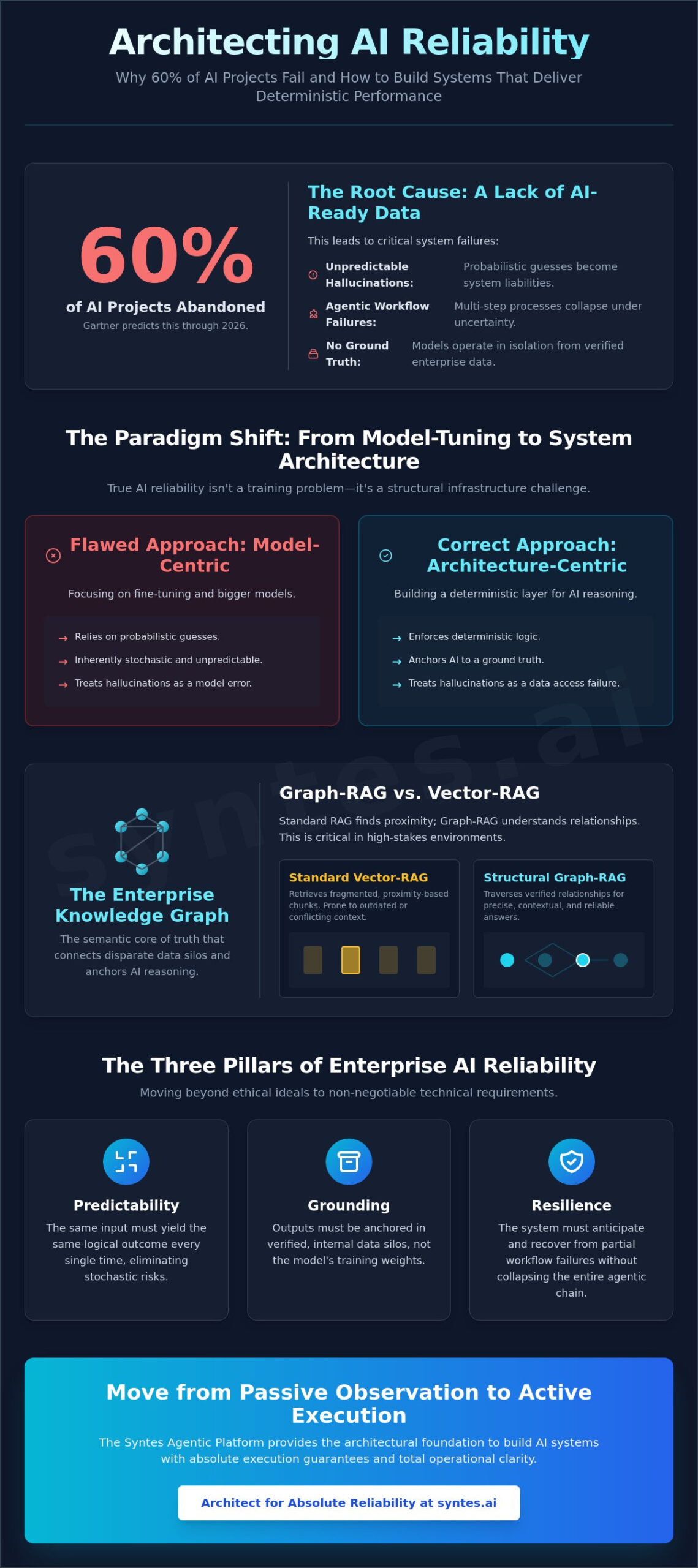
Probabilistic logic is a gamble. In a high-stakes enterprise environment, gambling with data represents an unacceptable operational risk that no executive should tolerate. While standard Large Language Models (LLMs) rely on statistical patterns to generate responses, they lack a fundamental understanding of objective fact. This is where the Enterprise Knowledge Graph becomes indispensable. It acts as the definitive source of truth, transforming AI from a pattern matcher into a logic engine. By mapping the complex relationships between entities, a knowledge graph ensures that AI reasoning is anchored in reality rather than probability.
Vector-RAG focuses on proximity. It finds data that looks similar to a query. In contrast, Graph-RAG focuses on structure. It understands how data points are connected. This distinction is critical for ai model reliability. Proximity-based retrieval often pulls irrelevant context if the semantic similarity is high but the logical relevance is low, leading to subtle hallucinations. Structure-based retrieval follows explicit, pre-defined paths of logic. It unifies structured databases and unstructured documents into a single, cohesive semantic layer. This allows the AI to understand relationships, not just patterns. It replaces the ‘best guess’ with a ‘verified path’.
We view the semantic layer as the nervous system of enterprise AI. It provides the connectivity required to move beyond the ‘black box’ problem inherent in standalone LLMs. When an AI can trace its reasoning back to a specific node in a knowledge graph, transparency is no longer an aspiration; it’s a feature. This transition from statistical guessing to logical verification is the only way to scale AI confidently across a global organization. It forces the system to show its work against a backdrop of verified corporate knowledge.
Reliability requires constraints. By embedding hard business logic into the data retrieval path, you ensure that AI agents operate within defined boundaries. Knowledge graphs allow for the validation of AI reasoning before it ever reaches the end user. This creates a closed-loop system where the AI learns from the graph’s structure. It’s a method of forcing ai model reliability through architectural design rather than hoping for better model behavior. You don’t just ask the AI to be right. You make it impossible for it to be wrong. This structural enforcement is the difference between a helpful chatbot and a reliable enterprise system.
Transitioning from theoretical potential to operational reality requires a technical blueprint. You don’t build a skyscraper on shifting sand; you don’t build enterprise AI on probabilistic prompts. To achieve ai model reliability, you must architect for determinism from the first line of code. This is a five step offensive to reclaim control over your data environment and force execution accuracy.
Reliable agents require state awareness. They must know where they are in a multi-step process and what has already occurred. Without this, workflows fracture. Implementing check-pointing in long-running AI tasks allows the system to pause, verify, and resume without data loss or logic decay. You must design agents that fail gracefully. When an integration times out or a logic gate is blocked, the system should trigger a pre-defined recovery protocol rather than hallucinating a shortcut. This is the operational core of the Syntes Agentic Platform approach.
Governance is not a manual checklist. It is an automated requirement. By embedding policy-as-code at the integration layer, you ensure that every agentic action complies with internal security protocols and external regulations. Ensuring ai model reliability through policy-as-code at the integration layer removes the burden of manual oversight. Policy-as-code serves as the digital guardrail that prevents AI agents from executing unauthorized actions or accessing restricted data silos. It turns compliance from a bottleneck into a competitive advantage. To secure your infrastructure today, explore the Syntes Agentic Platform.
The era of the experimental AI demo is dead. For global enterprises, the novelty of a generative response cannot compensate for the risk of systemic failure. We’ve identified the structural flaws that cause 85% of AI projects to stall. We’ve built the solution. The Syntes approach moves beyond the limitations of consumer-grade tools by treating ai model reliability as a non-negotiable architectural requirement. We don’t just provide a model; we provide the deterministic infrastructure required to make that model perform in a mission-critical environment.
The Syntes Agentic Platform marks the transition from passive reasoning to active execution. While standard AI tools offer suggestions, our platform orchestrates action across your entire technology stack. This is made possible through our Enterprise Knowledge Graph infrastructure, which effectively eliminates the hallucination trap. By forcing every agentic decision to be validated against a semantic core of truth, we ensure that your AI remains grounded in reality. This structural grounding is the only way to achieve sustained ai model reliability at scale.
Connectivity is the foundation of intelligence. Syntes connects legacy ERPs, CRMs, and disparate data lakes into a single, unified truth. We view this integration layer as the enterprise nervous system. In complex supply chain environments, our ‘Agentic Orchestration’ allows for real-time adjustments that are logically sound and operationally viable. Firms prioritizing systemic intelligence choose Syntes because we understand that an AI is only as reliable as the data it can access. We turn your siloed legacy systems into a cohesive, automated powerhouse.
Moving from an AI experiment to a full-scale AI operation requires a disciplined roadmap. We help enterprises navigate this transition by focusing on the ROI of reliability. Reducing error costs and increasing automation yields immediate financial impact. Gartner predicts that 60% of AI projects will be abandoned through 2026 due to poor data foundations. Syntes ensures you are in the successful 40% by providing the Cross-System Integrations and Knowledge Graph tools necessary for production-grade performance. It’s time to stop experimenting and start executing. Experience the Syntes Agentic Platform today and reclaim control over your AI initiatives.
The pursuit of enterprise intelligence ends where systemic fragility begins. You’ve seen the data: 85% of AI projects fail when they lack a structural anchor. By shifting your focus from model training to architectural integrity, you move beyond the hallucination trap. We’ve established that ai model reliability is achieved only when probabilistic reasoning is constrained by a semantic core of truth. This isn’t a future possibility; it’s a current operational necessity for any organization scaling beyond simple chat interfaces.
Success requires more than just better prompts. It demands a nervous system of seamless cross-system integration capabilities designed for autonomous operational tasks. The Syntes Agentic Platform provides this foundation, leveraging enterprise-grade Knowledge Graph infrastructure to replace statistical uncertainty with logical certainty. It’s time to bridge the gap between pilot experiments and production reality. Scale your AI initiatives with the Syntes Agentic Platform and secure your position in the evolving digital economy. Your path to absolute operational clarity starts with a deterministic architecture.
Enterprise reliability is the intersection of consistency, accuracy, and operational resilience within production environments. Unlike consumer AI, enterprise reliability requires that a system produces predictable, logically sound outcomes that adhere to strict business rules every time. It is about moving from probabilistic guesses to deterministic execution. You must ensure the system performs exactly as intended regardless of data volume or query complexity.
Measure reliability through execution success rates and the absence of silent failures. You must track how often an agent completes a multi-step workflow without manual intervention or logical errors. High-performing organizations monitor metrics at the semantic layer. This ensures that the agent’s reasoning remains anchored to the ground truth provided by their Enterprise Knowledge Graph rather than drifting into probabilistic synthesis.
Hallucinations occur because Large Language Models are stochastic engines designed for probability, not truth. Even with high-quality data, a model may prioritize a statistically likely token over a factual one if it lacks a deterministic constraint. Without a semantic layer to enforce relationships, the model treats data as a pattern to be synthesized rather than a logic to be followed. It fills context gaps with plausible fiction.
Yes, Knowledge Graphs eliminate the hallucination trap by providing a fixed, semantic structure for AI reasoning. By anchoring the model to an Enterprise Knowledge Graph, you force the system to validate every retrieval against verified nodes and relationships. This structural grounding replaces the black box synthesis of standard LLMs with a transparent, verifiable path of logic. It turns a guessing game into a lookup operation.
Accuracy is a measure of how often a model is correct in a controlled test; ai model reliability is the system’s ability to maintain that performance across unpredictable, real-world production workflows. A model can be 95% accurate on a benchmark but remain unreliable if its 5% failure rate occurs in mission-critical steps without a recovery protocol. Reliability demands systemic resilience, not just high scores.
Cross-system integration serves as the nervous system of reliable AI. Without real-time access to disparate data silos like ERPs and CRMs, AI agents operate on stale or fragmented information. Robust integrations ensure that the agent possesses full state awareness. This is essential for maintaining consistency across complex, multi-system enterprise environments. Integration is the difference between an isolated chatbot and an operational agent.
Most failures stem from a lack of AI-ready data and fragmented infrastructure. Gartner predicts 60% of projects will be abandoned through 2026 due to these foundational gaps. Common triggers include data drift, silent failures where monitored metrics appear normal while logic fails, and the cascading effect of minor errors in long-running, unconstrained agentic chains. Structural disconnects are the primary point of friction.
Absolute 100% reliability is an engineering ideal, but you can achieve near-deterministic performance by architecting for it. By utilizing the Syntes Agentic Platform and anchoring models to a semantic core, you minimize the probability of error to negligible levels. The goal is to build a system that fails gracefully and recovers automatically. This ensures total operational clarity and reduces risk to an acceptable enterprise standard.
DataRobot has been instrumental as we work through our generative and predictive AI use cases. With DataRobot’s LLM operations (LLMOps) capabilities and out-of-the-box LLM performance monitoring, we’re equipped to implement cutting-edge generative AI techniques into our business while monitoring for toxicity, truthfulness and cost.

Frederique De Letter
Senior Director Business Insights & Analytics, Keller Williams

A complete AI lifecycle platform is invaluable in optimizing the effectiveness and efficiency of our growing data science team. The DataRobot AI Platform provides full flexibility to integrate within our current ecosystem, including pulling data directly from Microsoft Azure to save time and reduce risk, and providing insights through Microsoft Power BI. This flexibility drew us to DataRobot, and we look forward to leveraging the integration with Azure OpenAI to continue to drive innovation.

Craig Civil
Director of Data Science & AI
The generative AI space is changing quickly, and the flexibility, safety and security of DataRobot helps us stay on the cutting edge with a HIPAA-compliant environment we trust to uphold critical health data protection standards. We’re harnessing innovation for real-world applications, giving us the ability to transform patient care and improve operations and efficiency with confidence

Rosalia Tungaraza
Ph.D, AVP, Artificial Intelligence, Baptist Health

DataRobot is an indispensable partner helping us maintain our reputation both internally and externally by deploying, monitoring, and governing generative AI responsibly and effectively.

Tom Thomas
Vice President of Data & Analytics, FordDirect
